 Big Bull Coin India
A defensible BIGB market cap and current sell depth could not be established from the reviewed sources. CoinMarketCap reports a self-reported circulation figure in its preview, and the Binance India information page marks BIGB unlisted. Liquidation value needs an executable market for the exact asset and size, even if a reference price and a supply figure can be multiplied. CoinMarketCap BIGB preview · Binance BIGB price page
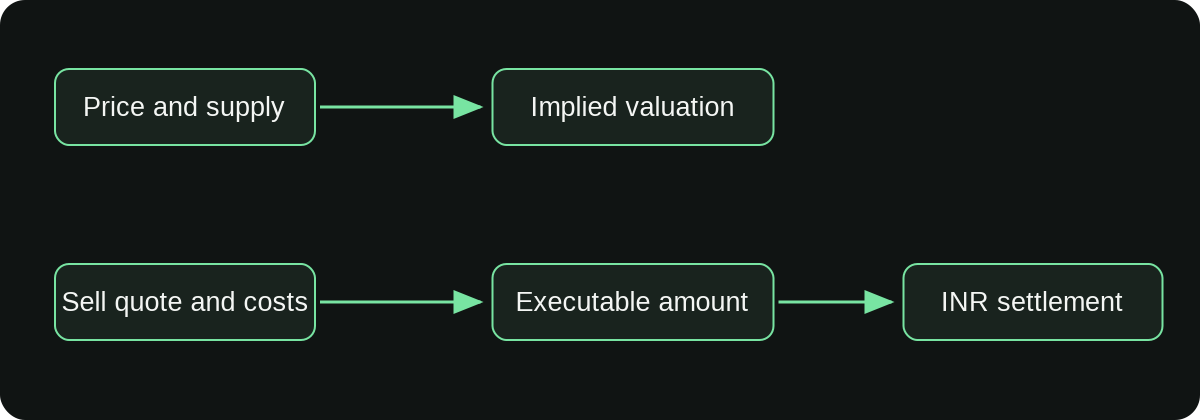
Market cap is a multiplication with two source requirements
For a conventional market-cap calculation, use a price and circulating supply for the same asset and time. CoinMarketCap's 400 million figure is self-reported and different from the total and maximum supplies shown by that provider. Other sources do not offer a consistent total either. If an analyst multiplies a historical contract's quote by the advertised mainnet's quantity, the unit may no longer match. Record the asset representation and source of each input before drawing a conclusion. A fully diluted figure should disclose the denominator and be kept in another column. BIGB supply reconciliation
Market cap represents an implied value using a marginal price. It is not money in an exchange or cash available to sellers. A circulating-supply estimate cannot tell you whether a given quantity can be sold. Conversely, a market with a modest number of available trades can still show a large implied valuation if someone multiplies a price by a large supply estimate. Use a depth test for sale by size.
Examine the actual exit size instead of the displayed price
On an order-book venue, use the buy side for a proposed sell order. Starting at the highest eligible bid, total the quantities and values until you reach the size or run out of visible depth. Divide the value by quantity to find the average estimated execution price before fees. Record the two most important limitations: the bids may change, and the snapshot may not show enough levels. A last trade or a candle cannot replace the book.
On a DEX, use a valid sell quote for the exact token and chain. Check the amount in, amount out, minimum received, gas and price impact. Compare one modest quantity and the actual intended size without submitting a swap. Confirm any intermediate assets and whether they can reach your INR settlement service. If a relevant pool or quote cannot be verified, write “unavailable for this analysis.” A returned quote is itself time-sensitive. PancakeSwap route checks
Four pieces of market evidence answer different questions
| Evidence | Question it can support |
|---|---|
| Matched price and circulation | A point-in-time implied market cap |
| Recent venue trades and volume | Where activity was reported and in which window |
| Bid depth or sell quote | How much could be sold under observed conditions |
| Off-ramp and bank route | Whether and how proceeds could reach INR |
Liquidity risk includes both the asset market and access. If you hold a token representation that cannot be deposited to the venue showing the price, its order book may be irrelevant to your exit. If a route shows capacity for smaller sizes, it might still be impractical after repeated fees or under withdrawal limits. Record the route without assuming that just because a quoted output is a stablecoin it will be accepted on the network you hold. A tax or withholding estimate belongs in a separate row. How to verify INR proceeds
Record negative results in a way that others can repeat
Identify the venue, attempt time, direction and intended size, then note which checks failed. If an information page says unlisted, quote that status as the finding for the exchange. If a decentralised service has no pool, record the exact identity criteria you used. If the route cannot be confirmed because identity is unresolved, describe that instead of saying no pool exists anywhere. This distinction helps a later reviewer understand whether conditions changed or whether the first observation had narrower coverage.
Market-cap and liquidity checks should be revisited on different events. A new supply reconciliation can update the first line while doing little for depth. A new listing can reveal a real price while supply still needs corroboration. A healthy two-sided quote during one hour can still deteriorate later. Keep these observations separate. A specific 2026 target can be evaluated only after clarifying whether the intended claim is an observed print or a price at which someone could sell a material number of coins. BIGB price scenarios
Compare two sizes before publishing depth claims
Set a small reference input and the full quantity you are testing. At the same time window, record the expected output for each size and include fees consistently. Divide net output by BIGB input for each quote. The difference between the unit rates shows how size affects the quote under the observed conditions. Do not multiply the small quote by the larger quantity without checking whether the route can support it. If you also observe the buy side, keep the direction attached. The cost to buy and the value obtained when selling can differ substantially.
The denominator for liquidity must match the assessment. If a site shows the total value of reserves in a pool, only part of that figure will be the quote-side asset, and extracting it would change the price. If a centralised market provides bids at five levels, you only have evidence for the depth visible within those levels. In either case, do not project unobserved capacity. An India-focused worksheet should keep these estimates separate from the bank-received value that would follow a successfully settled sale.
Frequently asked questions
Can an asset have a quote but no credible circulating market cap? Yes. The circulation figure can be missing or inconsistent for the quoted representation.
Does a large reported 24-hour turnover mean I can sell my full balance? Check depth, market access and executable output for your intended size. Volume covers past activity.
How should I report a failed quote? Record the venue, time, exact asset and test size, and explain whether the input was invalid, the route unavailable or the evidence incomplete.