 Big Bull Coin India
Public BIGB sources report conflicting supply figures. The Bigh Bull website says total supply is 1 billion, BitMart's project entry says 1.2 billion, and CoinMarketCap's preview shows a 500 million total and a self-reported 400 million circulating. The numbers describe different source records and should stay in separate rows. Bigh Bull · BitMart · CoinMarketCap
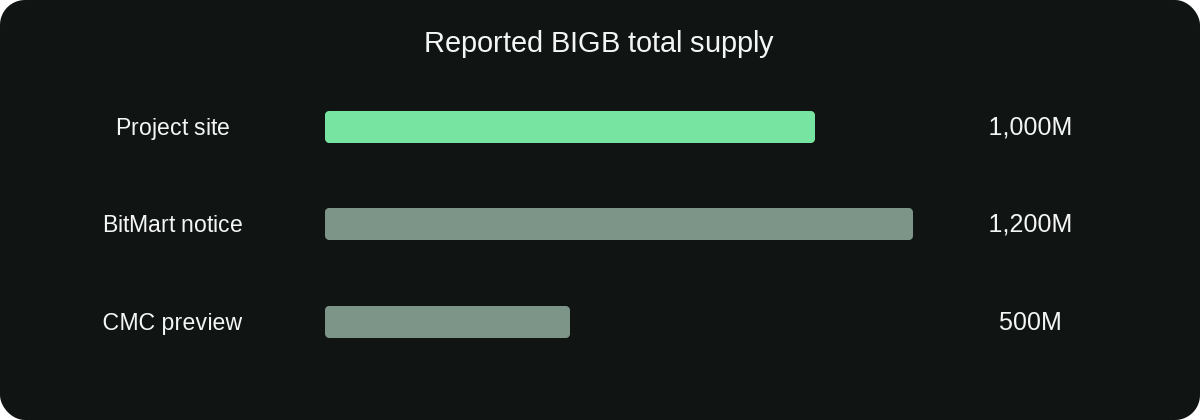
The supply figures and their evidence
| Source | Field | Reported amount | How to use it |
|---|---|---|---|
| Project website | Total supply | 1,000,000,000 BIGB | Attribute to the project and confirm against the stated mainnet |
| BitMart project notice | Total supply | 1,200,000,000 BIGB | Keep with the historical record and BEP-20 explorer reference |
| CoinMarketCap preview | Total supply | 500,000,000 BIGB | Treat as the field shown by this preview |
| CoinMarketCap preview | Maximum supply | 2,000,000,000 BIGB | Keep distinct from issued and circulating amounts |
| CoinMarketCap preview | Self-reported circulating supply | 400,000,000 BIGB | Preserve the self-reported label |
This is not a choice between numbers that can be averaged. Different dates, supply definitions or asset representations could account for discrepancies, but the figures alone do not establish which explanation applies. CoinMarketCap offers a separate circulation label instead of certifying that the displayed supply has been independently reconciled. The project mainnet explorer did not load during this review, so current issuance and distribution could not be verified there. Project explorer reference
What would make a supply comparison valid?
Start by matching the asset. On a contract network the chain and contract address are essential. A native coin may instead require a trustworthy network identifier and data at a distinct block height. Confirm the block height or date, then record the exact field the source reports. “Total supply” may indicate issued tokens under a particular contract, while “circulating supply” commonly excludes certain restricted or controlled balances under a provider's methodology. “Maximum” describes a ceiling under a specific definition. The metadata for each field matters as much as the figure.
For a credible comparison, verify whether an old representation has been retired, migrated, locked or left outstanding. If migration occurred, a useful disclosure would give the date, conversion ratio, eligible balances, address controls and reconciliation. Historical and new figures may measure overlapping claims on an economic unit. Adding them without proof can double-count supply. A burn address, locked balance or wallet with no recent activity should also be classified using evidence, because those labels can imply different spendability.
What can be said about distribution?
A token holder count is not the same as a count of beneficial owners. An exchange custody address can represent many customers, while one user or entity can control many addresses. A staking contract, treasury or bridge can have a large balance that serves a particular role. Separate addresses whose category is documented from addresses the researcher cannot identify. Avoid attributing ownership based on an unverified label or a search result.
To reproduce a top-holder calculation, record the network, exact asset, block height, source and denominator. Use the same source and scope for the numerator and denominator where possible. Decide in advance whether operational addresses are included and publish both the unadjusted result and any exclusions you can justify. A vesting schedule is a separate document. If there is no current, authenticated schedule, the division between investor allocations, team holdings and locked balances remains unverified. The numbers above do not establish an allocation table.
Why the distinction matters for valuation
Market capitalisation normally uses a price and a circulating-supply figure. A fully diluted estimate uses an explicitly stated diluted denominator. Neither measure is a guarantee that the market can absorb an order of that size. In BIGB's case, the choice of denominator is material even before price availability is considered. A reader should not multiply a historical contract's price by a claimed mainnet supply unless the sources establish that those two fields represent the same unit. Mark either input as unavailable if it cannot be aligned.
If you are building an INR research sheet, keep the fiat conversion in another column. Record the quote currency and conversion timestamp, and state whether the result is a converted reference or an exchange price you could have executed. A conversion cannot resolve an uncertain token supply or identify an active BIGB/INR market. Investors can compare information with other PoS coins by using the same column names, while leaving BIGB-specific gaps visible instead of substituting numbers from another protocol. How to identify the BIGB asset
A reconciliation sequence that preserves uncertainty
Open each source separately and save its exact field label. Record whether it identifies a native chain, a contract, or an unspecified representation. Then check whether a first-party migration or supply report identifies precisely which balances were included. If a dated ledger count becomes available, compare it with only the claims that refer to the same system and date. A table on an aggregator might change as project metadata is updated; preserve the original observation rather than reading the updated figure back into older research.
If you eventually build a valuation, keep supply and price independent until you can match both. A useful output can show a range of purely mechanical dollar values for several disclosed assumptions while explaining why none establishes actual market cap. Keep the rates and denominators visible to the reader. Exiting a position still requires verified two-sided quotes or a market with usable depth. The $0.10 scenario worksheet
Market cap and executable sell depth
Frequently asked questions
Does CoinMarketCap's 2 billion figure prove the project has issued 2 billion coins? It is displayed as maximum supply. Actual issuance requires current evidence for the matching network.
Can I calculate a circulating percentage from fields on two different sites? Only after reconciling chain, date and definitions. Keeping the calculation blank is more accurate when those inputs cannot be matched.
Does a fall in reported supply prove that a burn took place? A burn needs evidence such as a source-supported transaction or change under the relevant chain rules. A changed graph can also reflect a metadata revision.