 Big Bull Coin India
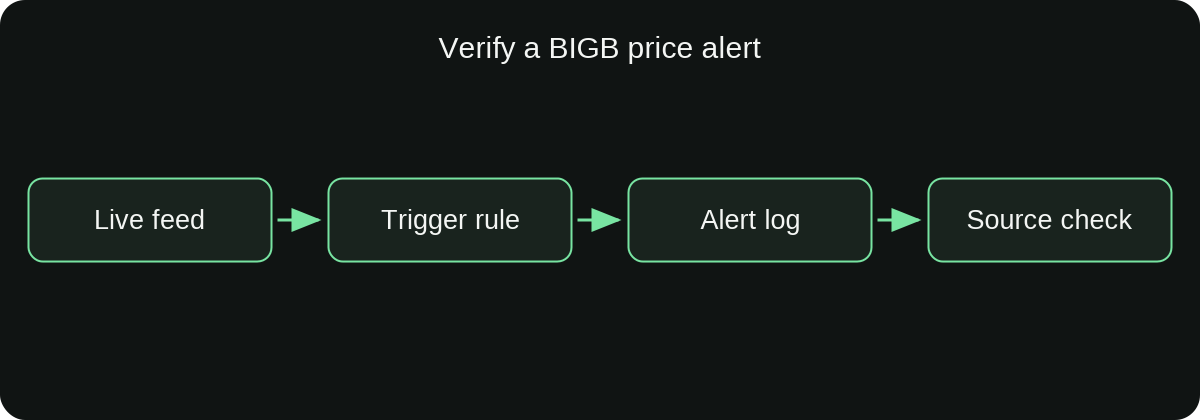
Start by checking whether the alert service has a live feed for the exact BighBull instrument. CoinMarketCap provides a BIGB preview, while the Binance India information page marks the asset unlisted and did not show a usable price in the reviewed text. In the absence of a verified source, use a manual watchlist or monitor for a listing update rather than assuming that a BIGB price alert will work. CoinMarketCap preview · Binance BIGB status
Decide what you need the alert to answer
A price alert reports that an input crossed a chosen boundary. If you are waiting for a first verifiable market, a price threshold is not the best first test. You need an official listing notice and an accessible instrument with actual quotes. If you already have a confirmed instrument, decide whether the threshold monitors a last trade, a close, or a reference price. These sources can trigger at different times even for the same market.
For an Indian reader, the currency can matter more than the label. A USD alert answers whether the dollar price crossed a line. An INR alert from an aggregator might reflect both the asset and a conversion rate. If the actual trading pair is in USDT, a USD threshold need not be identical to the service's number. Label each alert with the venue or data source, currency and exact asset. Choose whether you want a price crossing upward, crossing downward, or simply touching a level. Reading data fields and quote currencies
Create and test the alert without making a trade
- Select an exact instrument. Use the service's market description, exchange identifier and network where applicable. Search by full name and ticker and confirm the selection is not BBD or a similarly named token.
- Choose direction and timing. A rule based on intraday activity can behave differently from one checked at a candle close. Record the condition and how frequently it is evaluated.
- Name the alert clearly. Include BIGB, the source, unit and direction in the name if possible. Add the time zone to your note so you can compare it with an exchange record.
- Test notifications and review the outcome. Use the application's test feature if available or test its operation on another verifiable instrument. A successful notification test does not validate the BIGB feed. Inspect the BIGB source separately.
- Review expiration and continuity. Alerts can expire, be limited by a plan or stop when a market becomes inactive. Check the source after an unusual gap rather than assuming no price change took place.
TradingView's official documentation explains alert controls for supported symbols. The availability of a generic alert feature does not establish that it carries a suitable BIGB feed. Use the specific product's symbol and data rules, and do not assume that an alert from one platform will refer to the same market as another. TradingView alerts
What to do when an alert fires but the screen looks wrong
Check the trigger timestamp, the latest trade timestamp and the moment you open the chart. A price can briefly touch a level and then fall before your phone displays a notification. The alert may also use a slower data feed or a price from a different market. Use the alert's log if available and compare instrument and currency with the source. If the source value is missing or appears to match a stale observation, label the notification inconclusive.
Keep an alert log to avoid treating one notification as a reliable trend. Write the trigger, source, market, last trade time and whether an executable quote was available. A notification on a small last trade cannot reveal what a larger order will receive. If the reason you set it was to evaluate an INR outcome, verify sell-side depth and the route to the bank separately. Do not place an order just to discover whether the alert was reliable. BIGB to INR route
How to monitor a coin with no verified live feed
Create a manually labelled entry. Record the listing or quote source you checked, date of observation and what is missing. Set a reminder to revisit the official status or aggregator, instead of entering arbitrary values into the tracker. An official announcement is a reason to check when real trading begins, what exchange operates the market and which networks it supports. Keep any first quote documented against that same instrument.
| Watch item | Best first evidence |
|---|---|
| Official listing | Dated notice from the venue |
| Active trading | Current status and real quote or trade |
| Supported asset | Verified chain or contract and matching pair |
| Alert accuracy | Trigger log and independent price observation |
Check an alert's behaviour around thin trading
A feed may keep showing a last observed trade long after there are no new executions in its selected market. If a service updates an INR conversion while the underlying token quote is stale, a rupee threshold can appear to move even without a new BIGB trade. Keep the original trade time alongside the updated conversion time. In other cases, a threshold can be crossed by a single small trade. Record the relevant trade size when available. Those records tell you whether the alert says something about active trading, currency conversion or both.
Choose how to respond before the notification arrives. If you only want to know when there is a verified venue, open the listing notice and the market state. If you care about a potential INR exit, confirm the asset and sell quote at the size you would need. The same trigger can lead to different next checks depending on the goal. Close duplicate or obsolete alerts after a ticker or network change so a stale symbol cannot be mistaken for the intended position.
Frequently asked questions
Can two alerts trigger from the same price at different times? Yes. Market data, delay and rule evaluation can differ. Record the inputs and times.
Does a threshold send an order automatically? A notification-only alert does not provide an execution. Review the actual feature and do not assume an order was submitted.
Which currency should I choose if my budget is in rupees? Choose the source tied to your decision and keep the currency explicit. A translated reference value does not establish your real INR proceeds.