 Big Bull Coin India
A BIGB price page is available, but a current executable BIGB quote was not verified in the sources reviewed. CoinMarketCap labels its page a preview. Binance's India-facing price page shows an unlisted notice and, in the observed page text, leaves the price value blank. Treat those observations as data limitations rather than a price of zero. CoinMarketCap BIGB · Binance BIGB
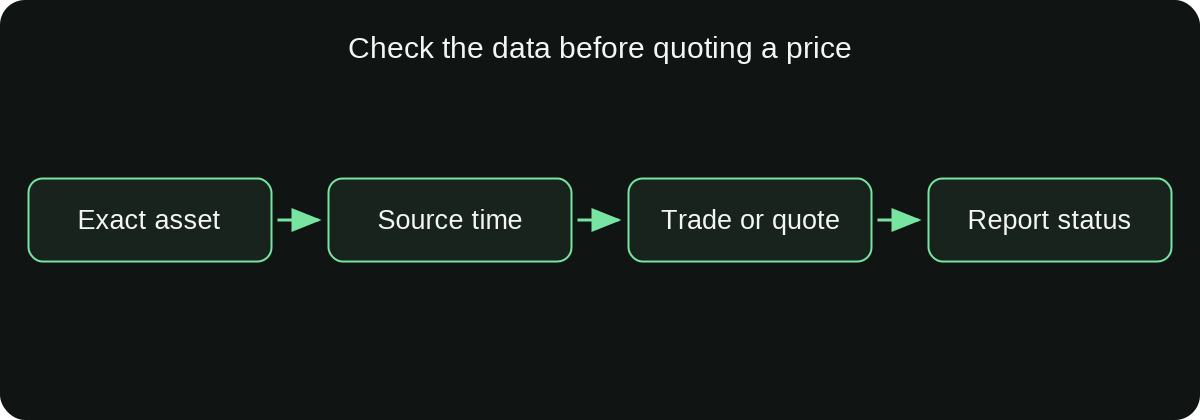
What a useful quote needs to show
Begin with four details: the exact asset, the venue, the quote currency and the timestamp. A price that has all four can still be a last trade rather than an available price for your order. Look at whether it is a price derived from a trade, a modelled aggregate, a midpoint or an executable bid or offer. A swap quote is specific to the route and output size. A large order may cost more per coin than the quote for a very small order.
A BIGB symbol without the network can refer to a historical BNB Chain record or a native-coin context. Do not paste a chart value into a portfolio until you can connect it to the asset you actually hold. If the source is a DEX tracker, cross-check the network, contract and pool address against a reliable asset source and inspect the quote token. A token whose name resembles BIGB is not enough. BighBull identity guide
Missing data, 24-hour volume and stale prints
When a page shows no numeric price, the safest status for a price table is “unavailable from this source”. A zero displayed beside 24-hour volume does not prove a simultaneous zero price. It can describe the provider's observation window or lack of tracked trade data. A flat 24-hour percentage is also ambiguous if its input is absent. Read whether the provider named a current market and whether the units and publication time are visible.
| What the page shows | What to record |
|---|---|
| Blank price or unlisted notice | Data or market limitation, with the source and date |
| A trade with an old timestamp | Last observed trade, with its actual time |
| Aggregated 24-hour volume | Provider, market coverage and observation window |
| A size-specific buy or sell quote | Direction, amount, fees, timestamp and output |
A high historical trading volume does not establish current depth. A low or missing reported volume can also reflect sources the provider does not track. The 24-hour window may be rolling rather than an Indian calendar day. Convert timestamps explicitly if you plan to compare records in IST. Avoid filling missing dates by repeating the previous day's trade and then calling each entry a new observation.
Can you name an all-time high from a partial chart?
A reliable all-time-high statement needs a defined data universe. That means the instrument and network, tracked venues, start and end dates, quote currency and rules for selecting a historical price. A single old, thin trade may be the observed high in one dataset and poor evidence for a broad project record. If the source offers historical data without showing a continuous or appropriate market, write “highest observed in this series” and name the period. If the coverage itself is unclear, do not put a numeric all-time high in the title.
Retain the raw values and the candle's time boundaries if deriving a high from a chart study. Some interfaces use daily close while others draw the intraday high. Those are different. Inspect whether the series reflects a migration or catalogue change before linking periods. If a source changed its reported supply at the same time, do not assume that the chart adjusted prices automatically. Supply record comparison
Convert a verified price to rupees without inventing a market
If a valid quote is in US dollars, the reference INR value is USD per BIGB multiplied by INR per USD at a stated time. If the quote asset is USDT, you need either a justified direct INR conversion or a USDT-to-USD leg plus the USD-to-INR leg. Record each source and timestamp. This gives a reference value, not proceeds in a bank account. To estimate proceeds, use the executable sell output, conversion charges, any applicable withholding and the withdrawal route.
For recurring monitoring, keep separate fields for observation time, last trade time, quote type, price, volume, exact asset and coverage gaps. If an alert service supports the asset, set an alert only after verifying its source uses the desired market. An alert on a general aggregator can differ from a size-specific wallet quote. The alert tells you that its input crossed a rule, not that your order could fill.
Set a price alert only after checking the alert's data source
Name alerts with the market and unit, such as a documented BIGB quote against USD on a named venue. Set the threshold and direction, then inspect whether the system can still see a current instrument. Keep the trigger time apart from the last-trade time; an alert engine can re-evaluate a delayed or stale input. If the service cannot show its source or has no exact asset, use a watchlist entry for manual checks instead of choosing another token with a similar symbol. When a notification arrives, compare the trigger with the source and only then inspect a current quote for the order size you care about.
For a repeatable daily record, use one snapshot time in IST and keep the UTC source times intact. A day with no eligible observation should remain a gap. This helps distinguish a quiet series from a provider with interrupted coverage and prevents volatility from being calculated using invented trades.
Frequently asked questions
Can I set an alert from a chart that currently has no live price? An alert needs an available data feed. Check the source and market before relying on a notification.
Why do two BIGB price pages disagree? They may show different assets, market coverage, currencies or times. Compare those identifiers before comparing values.
Is the last traded price adequate for an Indian tax record? It is one possible supporting value only if it relates to the actual asset and relevant time. Keep transaction consideration and reliable INR records separately. India VDA tax records