 Big Bull Coin India
Bigh Bull describes its advertised mainnet as proof of stake, with validators maintaining the blockchain. Its public overview gives the consensus label, but it does not provide enough operational detail to confirm validator selection, finality, penalties or user staking rules independently. Bigh Bull blockchain overview
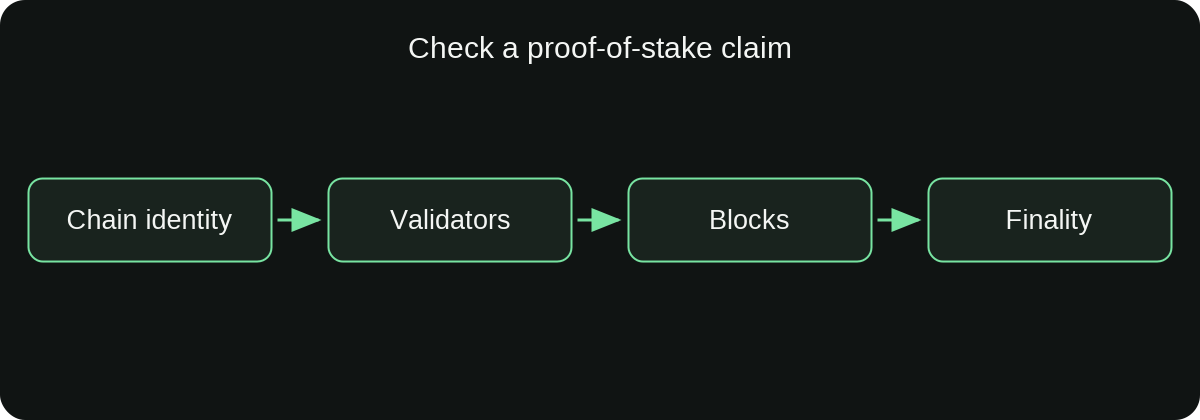
What proof of stake generally describes
Proof of stake is a family of mechanisms in which stake, directly or indirectly, helps determine participation in consensus. A validator may propose or attest to blocks according to network rules. Consensus determines which state is accepted when nodes have competing information. Networks can differ substantially in their rules for validator entry, minimum stake, delegation, rewards, downtime and penalties. A high-level label does not specify whether features exist or how they work in one particular implementation. Ethereum's official documentation is an example of a network explaining its own rules in detail, and serves here only as a reference for the kinds of questions to ask. Ethereum proof-of-stake documentation
The Bigh Bull page uses the term forging for PoS validation. Treat that as terminology from the project. A claim about the mechanism becomes operational when it is tied to the running software or the network's verifiable state. There should be a way to identify the chain and determine which nodes, validators or other entities actually participate. Without it, we can report the declared architecture, but cannot attribute features common elsewhere to BIGB.
What to look for before calling the network decentralised
Begin with a chain identity. A reliable guide should name the mainnet, its chain identifier where applicable, and endpoints documented by the project. Next, look for a public record of blocks by height, timestamp and producer. Observe more than one block, and where possible verify data through a separate trusted source. If all public views depend on one operator, write down that limitation.
| Question | Evidence that would help answer it |
|---|---|
| Who can validate? | Protocol specification and entry requirements |
| Who is validating today? | Current validator set with voting or staking weights |
| How is a transaction considered final? | Network-specific finality and reorganisation rules |
| Can a holder delegate? | Current staking interface and its governing terms or code |
| What can reduce rewards or principal? | Penalty, slashing, downtime and lock-up rules |
A list of validator names is only a starting point. Several names may share control, and nodes and validators can be distinct roles. A count does not show the distribution of voting weight. If the network exposes weights, compare top operators over multiple blocks or epochs and state the scope of the measurement. Do not infer consensus control from a token-holder list on BNB Chain. That list describes addresses recorded by a contract or analytics source, and it may be unrelated to the validator set of another chain.
What BigB Scan can and cannot establish
The project identifies BigB Scan as its explorer. We could not access the explorer during verification, so this article cannot confirm recent blocks, the active validator set, or how confirmations appear in the interface. An inaccessible explorer is a limit on verification, not proof that a blockchain has stopped. An independently maintained endpoint or dated first-party documentation could help resolve part of the gap. For a user trying to identify an old BNB Chain record, the exchange-linked explorer reference serves a different purpose. BigB Scan project reference · BitMart historical BIGB entry
A snapshot that simply shows a rising height would be useful evidence of activity at the time of observation. It would still leave other questions open. Check a block's timestamp, the range examined and whether the source shows old or recent data. If a source exposes the producer for each block, a short observation period can identify concentration in that window. State the period and sample size. This avoids turning a few visible blocks into a claim about long-term decentralisation.
Block production is distinct from earning rewards as a user
A chain can be described as proof of stake without providing a public delegation product to every coin holder. Delegation, exchange earn accounts and a third-party lending or deposit scheme have different mechanisms and responsibilities. An advertised annual rate does not reveal which one you are looking at. Before evaluating a rewards offer, establish who controls the asset during the term, how withdrawals work, where any rewards come from and whether there is a current document you can authenticate.
A beginner can learn the process without sending funds. Write down whether the source shows validator operation, a delegator's position, an exchange balance, or merely an earnings claim. Ask for an independently verifiable source before equating any one of those with the others. Under India's compliance framework, the status of an intermediary is considered separately from the chain's consensus. If documentation does not supply a current route, a generic Binance or wallet tutorial cannot provide that missing evidence. FIU-India VDA guidelines
Compare BIGB with another PoS network on the same questions
For an educational comparison, place the network documents side by side and fill in consensus, onboarding, delegation, reward evidence and finality. Ethereum's public specifications describe active duties and penalties, which gives readers an independently checkable reference point. For BIGB, the public project page supplies the PoS claim and explorer reference. Mark the other fields as unverified until operational documentation is available. Leave each field attached to its own network. The method lets you compare documentation coverage without accidentally introducing Ethereum's validator requirements, withdrawal conditions or penalty amounts as features of Bigh Bull. Ethereum rewards and penalties
Frequently asked questions
Does a PoS chain automatically have a staking minimum? The design may define one or use other rules. Use the network's own specification before quoting a number.
Can an old BIGB balance validate mainnet blocks? A balance on a different network does not establish eligibility. Look for documentation that ties that representation to mainnet validation.
How can two explorers show different confirmation counts? They may follow different networks, update at different times, or define the displayed count differently. Identify the chain and the block height before comparing.